
APS Technology
APS Technology page header

White Papers, Technical Articles & Publications

Active Vibration Damper Improves Performance and Reduces Drilling Costs – WorldOil, September 2008

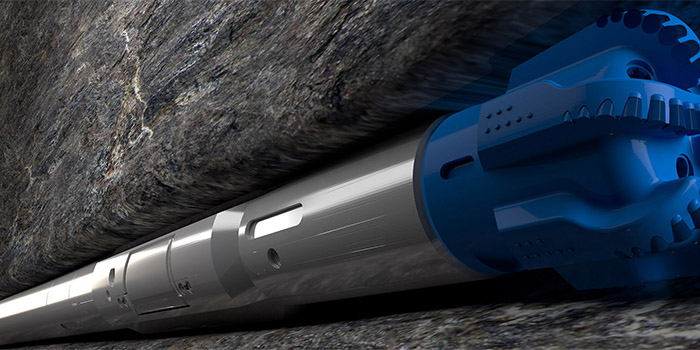
A novel tool designed to detect and react to drillbit vibration was tested at the Rocky Mountain Oilfield Testing Center (RMOTC), located in Teapot Dome Oil Field, also known as Naval Petroleum Reserve No. 3 (NPR-3), near Casper, Wyoming. This new tool, the Active Vibration Damper (AVD), developed by APS Technology, Inc., monitors vibrations in the BHA and adjusts the damping coefficient to reduce them. This was the first field test of the device, which had previously been tested at a drilling laboratory.

Drilling Tests of an Active Vibration Damper

Drillstring vibration is a serious problem, particularly in deep and hard rock drilling; it can reduce the rate of penetration (ROP), shorten bit life, and damage expensive downhole components. Testing of an active drilling vibration damper (AVD) system at TerraTek Laboratory, under conditions designed to induce vibration, demonstrated that the use of the AVD reduced vibration, maintained more consistent weight-on-bit (WOB) and increased ROP.

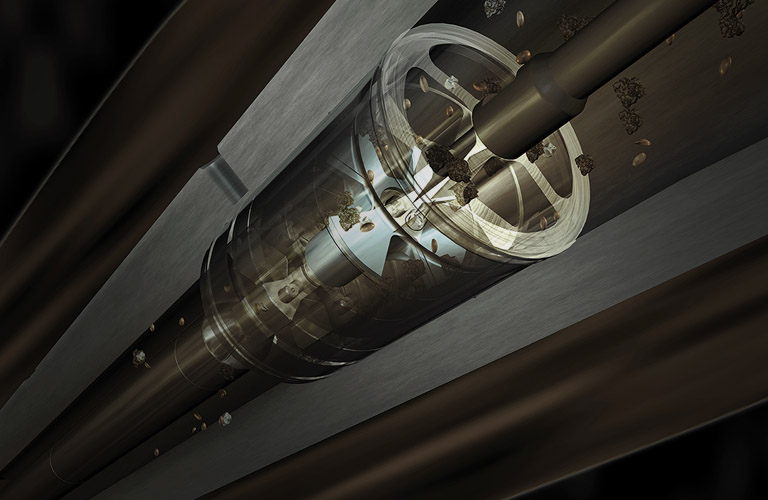
The AVD has a structure similar to that of a shock sub with the shock absorber filled with magnetorheological fluid (MRF), rather than hydraulic oil. Under the influence of a magnetic field, MRF instantaneously increases its viscosity. Using a series of coils to induce intense electromagnetic fields across the fluid gap, the damping coefficient can be changed in milliseconds by a factor of 7-10. A linear motion detector provides feedback to control the AVD in response to bit motion.

In these tests, the AVD was used behind a tricone bit to drill through blocks of hard concrete, each of which had a 12" granite slab mounted within it at a 10° angle. By inducing an asymmetric load on the bit, the interfaces produced severe vibration during drilling the control holes. A total of 28 holes were drilled, including 11 control holes, at varying WOB and rotation rates.

Analysis of the data confirmed the anecdotal observations made during drilling. The vibrations at the bit were reduced significantly; the variation of the measured WOB was significantly curtailed, and the ROP was increased. These tests demonstrated that the AVD is likely to provide significant time and cost savings, particularly in deep wells. These will arise, not only from the increased instantaneous ROP, but also from fewer trips for bit or equipment changes, and lower costs for replacing damaged MWD tools, motors or other expensive components.

Laboratory Testing of an Active Drilling Vibration Monitoring & Control System

The deep, hard rock drilling environment induces severe vibrations, which can cause reduced rates of penetration and premature failure of the equipment. Conventional shock subs are useful in some situations, but often exacerbate the problems.

APS Technology is developing a unique system to monitor and control drilling. This system has two primary elements: (1) An active vibration damper (AVD) to minimize harmful vibrations, whose hardness is continuously adjusted. And (2) A real-time system to monitor drillstring vibration and related parameters. This monitor adjusts the damper according to local conditions.

New Isolator for Controlling BHA Vibrations

APS Technology is pleased to announce the successful deployment of 6-3/4" Drilling Isolation Subs to the North Sea and Canada. A major international service company has integrated the novel design into a Multi-lateral completion system. The sub is used in the initial BHA to both cut a casing window and drill 30 feet of new formation successfully protecting setting tools instrumentation, enabling the program to proceed.

Since the following paper was written, the design has been successfully tested both in the lab and on drilling machines at all applicable levels of WOB and drilling torque. The concept has proven both rugged and strong enough to stand up to the rigors of the drilling environment, and APS is currently preparing to deliver other sizes. The first 4-3/4" tools should be delivered in Q4 2004.

Drilling Vibration Monitoring & Control System

The deep hard rock drilling environment induces severe vibrations into the drillstring, which can cause reduced rates of penetration (ROP) and premature failure of the equipment. The only current means of controlling vibration under varying conditions is to change either the rotary speed or the weight-on-bit (WOB). These changes often reduce drilling efficiency. Conventional shock subs are useful in some situations, but often exacerbate the problems.

APS Technology is developing a unique system to monitor and control drilling vibrations in a 'smart' drilling system. This system has two primary elements:

  • The first is a multi-axis active vibration damper to minimize harmful axial, lateral and torsional vibrations. The hardness of this damper will be continuously adjusted using a robust, fast-acting and reliable unique technology.
  • The second is a real-time system to monitor 3-axis drillstring vibration, and related parameters. This monitor adjusts the damper according to local conditions. In some configurations, it may also send diagnostic information to the surface via real-time telemetry.

Preliminary Testing of a Novel Downhole Fiber Optic Fluid Analyzer

A novel fiber optic downhole fluid analyzer has been developed for real-time determination of the oil, gas and water fractions of fluids from different zones in a multizone or multilateral completion environment. A near-infrared attenuation measurement provides differentiation among oil, water and gas at all but the highest water cuts. An induced fluorescence measurement unambiguously determines the oil fraction of the fluid as a validity check on the attenuation measurement. The only downhole components of the system are the fiber optic cable, lenses and windows, which may be installed in multiple locations in the well and operated with a single surface unit.